
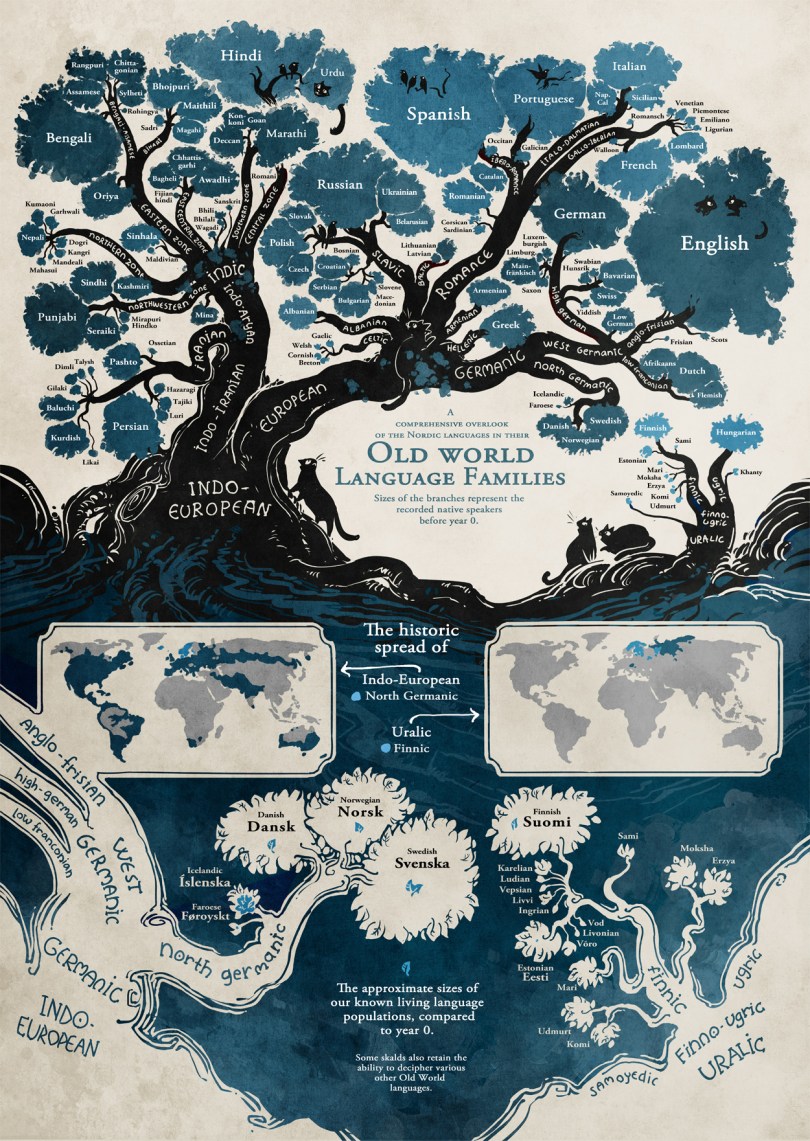
He who knows nothing of foreign languages, knows nothing of his own. / Wer fremde Sprachen nicht kennt, weiß nichts von seiner eigenen.
– Johann Wolfgang von Goethe
One of things that has always fascinated me, ever since I started to learn foreign languages, was the similarities. Finding little pieces of one language in another always feels a bit like opening a present for me. I love to look for them and I love to learn about them. I adore it when one of my English students tells me “hey, that sounds a lot like X that we say!”
These connections and patterns are like a giant jigsaw puzzle, if you can figure out how/where/why these words transferred from one language into another, you’ve probably learned a bit about history, about your language, and about how we all fit together.
I like to remember, no matter how different our languages seem, we are, in essence, just trying to communicate with our fellow humans. That’s why we often steal words from other languages – because we didn’t have a word for it, or someone else’s word was just so much better, or it brought a new nuance in meaning. Of course these similarities can also be used to track human migrations and the expansion of civilizations (Rome and the Latin footprints it left all over most other European languages is a prime example).
Linguists theorize that at some time in the past there was only one language. But of course tracking it down and proving this theory is impossible, as those humans would have never written their language down. However, we can see evidence that points us in this direction in the Indo-European languages. Without getting too technical, that’s why the word for brother in most of the European languages start with b or p or sometimes v or f – these sounds are very similar. Linguists track these similarities across thousands of words and hypothesize about what the base word in Proto-Indo-European would have been. (It would have been bʰréh₂tēr, if you’re wondering.)
So, when it comes down to it, we’re all speaking various forms of the same proto-language and each language carries around the evidence of its interaction with other speakers from different areas, of different eras in time, and connects us through time and space with the humans who came before us and those that will come after us. Language is a powerful thing.
Language Tree created by Minna Sundberg for her webcomic Stand Still Stay Silent.
 Shaunna Lucas / A Wild Anthropologist